Printing

Create Paper and PDF Docs

Print to a PDF file or a device. View, edit, and compress PDF files.

Manage printers using System Settings.

Manage printers using System Settings.

Please read the disclaimer before proceeding. We review and update guided solutions regularly. If you have suggestions or requests, please write support@kfocus.org.

Print to File

One doesn't need to print to paper or other media very often these days. With email and instant messaging, it is often easier to record and send content electronically. One may, for example, share screencasts, images, or PDFs.

Any app that can print to a device can also print to a PDF file. PDFs have some advantages over other recording techniques. Humans and machines can quickly search and index PDFs, whereas searching a video or image is far slower and less accurate.

Most apps in Kubuntu use the system print interface, which is shown below.

Export PDFs from KDE apps using the Print feature.

Export PDFs from KDE apps using the Print feature.

Customize the PDF's paper size.

Customize the PDF's paper size.

Some apps provide more PDF options than others. LibreOffice, for example, has basic and advanced PDF setting.

Export PDFs directly using LibreOffice.

Export PDFs directly using LibreOffice.

Customize LibreOffice PDF export options.

Customize LibreOffice PDF export options.

Chrome has a custom print interface and does not print background images by default. This helps save ink.

Print to PDF with Chrome.

Print to PDF with Chrome.

Choose 'Save as PDF' to use the PDF printing feature.

Choose 'Save as PDF' to use the PDF printing feature.

Enable background graphics to improve PDF export quality.

Enable background graphics to improve PDF export quality.

Click 'Save' to export the web page.

Click 'Save' to export the web page.

Print to Device

Overview

A printer must be configured before it can be used. Happily, Kubuntu will usually discover and configure most printers automatically. With most apps, use [ File ] > [ Print ] to open a print dialog, select the destination printer, and click [ Properties ] (or similar) to adjust options.

Auto-Discover and Configure

Kubuntu should auto-discover and configure most modern network printers. Before you boot your system, turn on your printer and attach it to the network. After you boot and sign-in, visit [ System Settings ] > [ Printers ]. Here you should see your printer in the left-hand column. You may then click [ Maintenance ] > [ Print Test Page ] to verify it works.

Auto-discover and configure printer

Auto-discover and configure printer

Sometimes multiple devices will appear for a single printer. Usually, this happens when print and fax capabilities are both available. After determining the preferred device, set the default printer using [ System Settings ] > [ Printers ] > [ (printer model) ] > [x] Default Printer.

If you attached a printer and it does not appear, try rebooting your system and cycling the printer power. If that doesn't work, click [ Add Printer ] to find it. You may need to Set a Static IP, as discussed at the end of this section. If you are using a USB printer or have other issues, see the Troubleshooting section for more ideas.

Configure Printer

To change a printer configuration, click [ Configure ]. In the [ Modify Printer ] tab, you can change the Description and Location. We do not recommend changing the connection or driver fields unless you really know what you are doing.

Configure printer: Modify Printer

Configure printer: Modify Printer

In the [ Printer Options ] tab, you can select the default paper size along with other features like quality and 2-sided (duplex) printing. The system only shows supported options. For example, if your printer does not support 2-sided printing, the system may omit that option, as illustrated here.

Configure: Printer Options

Configure: Printer Options

Set a Static IP

If your printer constantly reconfigures on boot, your router’s DHCP might change the printer’s IP on every power cycle. If this is troublesome, you can configure your router to reserve a static IP address for your printer; see your router manual for details. You can then test a static IP connection using a Konsole terminal. For example, if you set the IP to 10.0.0.25, use ping 10.0.0.25 to see if the printer is available on the network. Beware, however, that some printers may need to be configured to respond to ping requests; see the printer manual if this appears to be the case.

Set the Default Paper Size

Overview

Usually, the default paper size will be US Letter or A4, depending on your printer and locale. You can adjust this in 4 locations: the CUPS Printing System, Regional Settings, Printer Settings, and in an app. Below, we show how to set US Letter in all these locations.

The CUPS Printing System

Open a Konsole terminal, enter the following line, and press [ Enter ]. Example output is shown in the comments. See man paperconfig for more details.

# Set default CUPS paper size to letter # Change to 'a4' for A4 size. sudo paperconfig -p letter; #> tl-paper: setting paper size for context to letter #> ... #> Running mktexlsr. This may take some time... done. #> Building format(s) --refresh. #> This may take some time... done.
Regional Settings

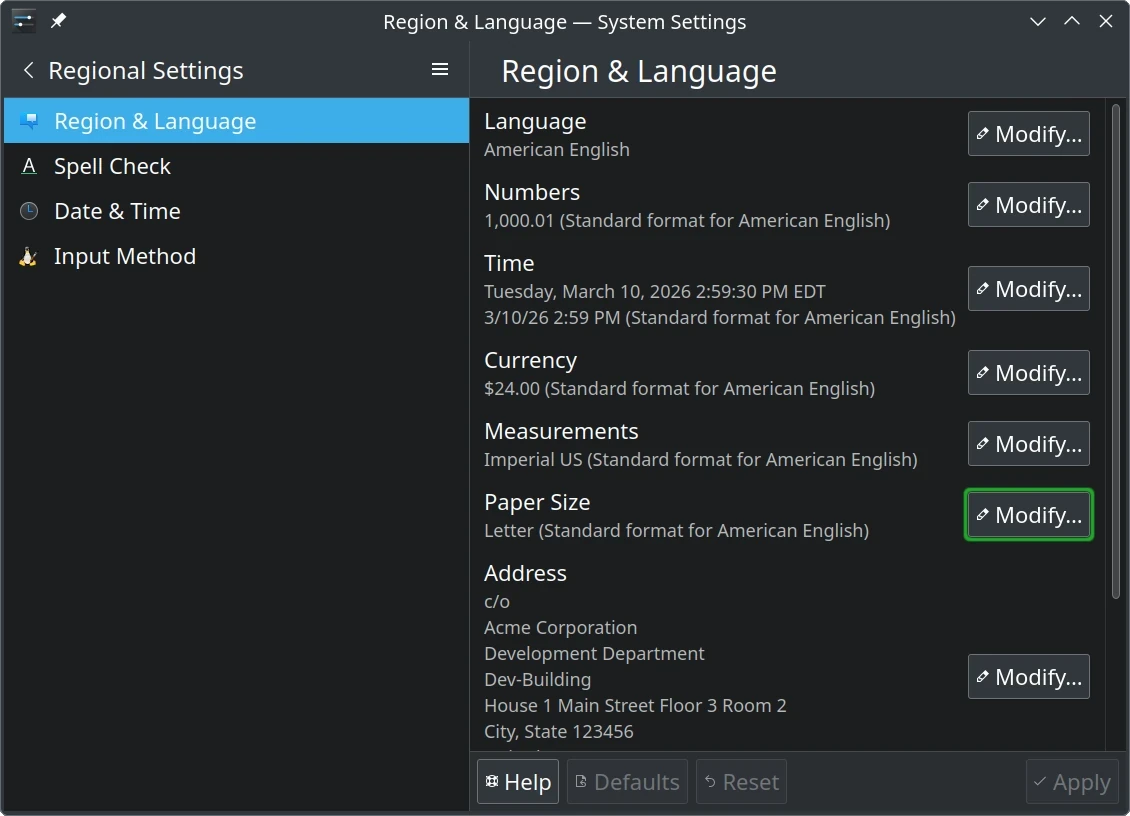
Use [ System Settings ] > [ Regional Settings ] > [ Region and Language ] > [ Modify ] to adjust the paper size for your region.

System Settings > Regional Settings > Region and Language

System Settings > Regional Settings > Region and Language

Printer Settings

See Print to Device section to set a printer's default paper size.

In an App

This section shows how to set a default paper size in LibreOffice Writer. Other apps will vary, but the same principles often apply.

  • Open a new, blank Writer document
  • Go to [ Format ] > [ Page Style ] > [ Page ] tab
  • Set [ Paper Format ] to [ Letter ]
  • Click [ OK ]
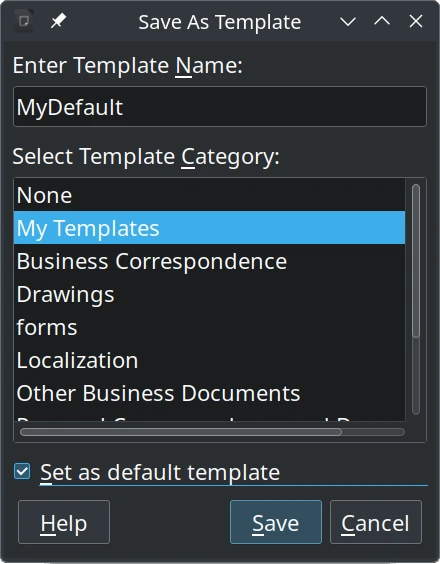
  • Go to [ File ] > [ Templates ] > [ Save as Template ]
  • Name the template (e.g., "MyDefault")
  • Select the "My Templates" category
  • Check the box [x] Set as default template
  • Click [ Save ]
LibreOffice Writer Default Template

LibreOffice Writer Default Template

Documents created by others typically have a paper size already defined. For example, when you view a PDF in Okular, you can see the defined paper size using [ File ] > [ Document Properties ]. If the document paper size does not match your printer's, you may need to change it in the app. In some apps, you may also adjust the paper size in the print dialog ([ File ] > [ Print ]) by clicking on [ Properties ] (or similar) next to the selected printer.

View and Edit PDF files

Okular is the default PDF viewer for Kubuntu. It has support for virtually all PDF capabilities, such as search, annotation, and forms. Click [ Tools ] > [x] Annotations to show the annotation tools.

PDF Arranger (formerly PDF Shuffler) rearranges, removes, and adds pages to a PDF document. DiffPDF visually compares PDF files.

Focus systems come with shrinkpdf which can reduce PDF files to as little as 5% of the original. It does this by lowering image quality 96 DPI. This is only noticeable only when printed on paper. You can edit this script to adjust the DPI if you wish.

Duplex Printing

Most modern printers can print on both sides of a page. This feature is called "two-sided" or "duplex" printing.

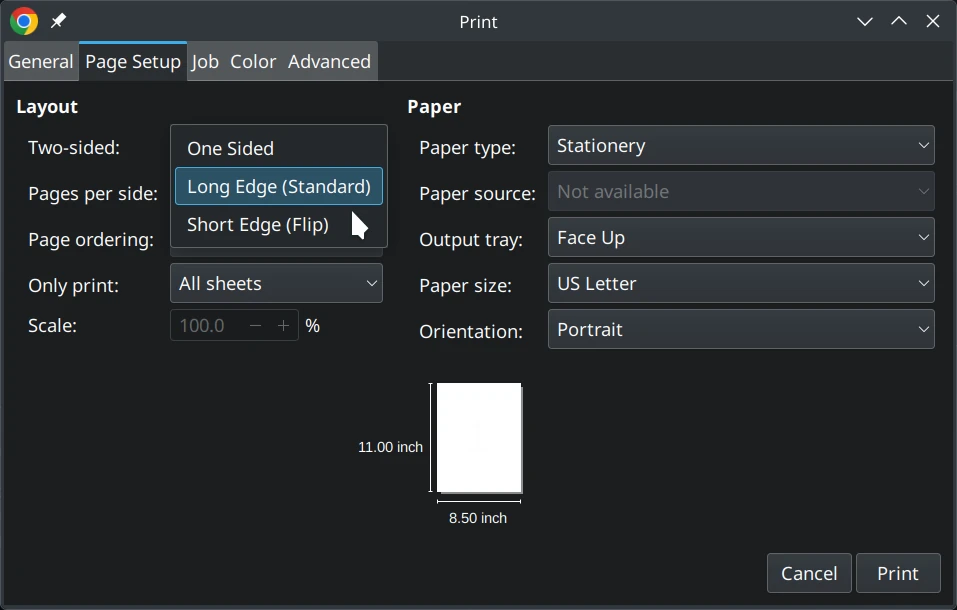
In many apps, you can activate this feature under [ Print ] > [ Page Setup ] > [ Two-sided printing ]. In KDE apps, you can activate it with [ Print ] > [ Options button ] > [ Options tab ] > [ Double Sided Printing ].

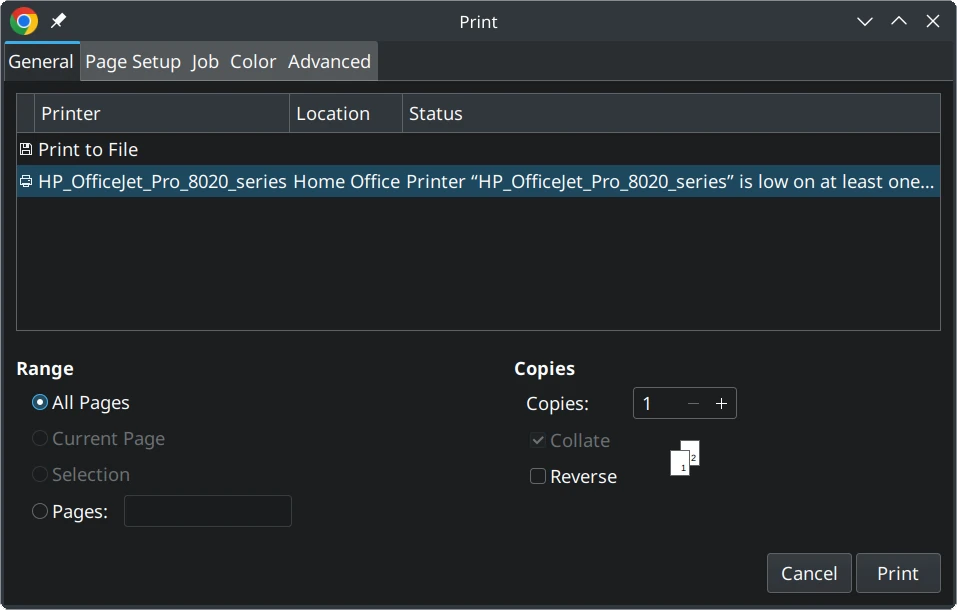
The images below show how to do this in the system print dialog shown by Google Chrome.

1. Click the printer you wish to use.

1. Click the printer you wish to use.

2. Navigate to and enable duplex printing.

2. Navigate to and enable duplex printing.

HP Device Manager

We no longer recommend HP Linux Imaging and Printing (HPLIP), as the standard CUPS interface works well for advanced features such as automatic document feed. Apps such as SkanPage (our preference) or SkanLite work well to scan documents without HPLIP, and many HP printers now offer a web interface for scanning too. For most people, HPLIP simply complicates the standard CUPS printing system. If you have installed it, you can remove and refresh CUPS as below:

# Uninstall hplip sudo apt purge hplip-data hplip-doc hplip-gui hplip; # Reinstall CUPS packages sudo apt install --reinstall cups cups-client cups-common cups-core-drivers cups-daemon cups-filters cups-ppdc cups-server-common; # You may need to reboot to reinitialize printing daemons

Troubleshooting

Q: I'm using a VirtualBox Virtual Machine (VM), but don't see my network printers. What can I do?

A: In VirtualBox, select your VM, then adjust [ Settings ] > [ Network ] tab and change the [ Attached To ] selector to [ Bridged Adaptor ] and click [ OK ]. The VM OS should now be able to discover the network printers.

Q: I don't see my USB printer. How can I use it?

A: The system may not auto-discover and configure a USB-attached printer. To add it, visiting [ System Settings ] > [ Printers ] and then click [ Add Printer ]. In the [ Select a Printer to Add ] dialog, give the system 20-30 seconds to search for printers. Then select your printer from the locally attached devices.

If you still don't see your printer, close the System Settings window, turn your printer off, wait 30 seconds, turn it on, wait 30 seconds, and then try again. Once you see your printer, select the top choice and click on [ Next ]. Accept the default PPD and click [ Next ]. Then keep [x] Share this printer and click [ Finish ]. Then try to print a test page as described in the Print to Device, above.

Q: I can't get a test page to print. I used [ System Settings ] > [ Printer ] and selected [ Maintenance ] > [ Print Test Page ]. I got an "Unable to open print file: Permission denied" error. What can I do?

A: Make sure the user is in the lp group by typing groups into a terminal. If you don't see lp there, you can add it with sudo usermod -a -G lp $USER and then log out and back in. Source: Ask Ubuntu. If that doesn't work, you can reinstall key services, sudo apt reinstall cups-daemon cups-server-common cups cups-client; then reboot and then try adding the printer again.

Q: I still can't print. This time, I see "No suitable Destination Host found by cups-browsed". What could be the problem?

A1: There appears to be a bug in cups-browsed that causes this problem for some printers. First, visit [ System Settings ] > [ Printers ] and select the printer to test. Next, click on [ Open Print Queue ] and delete all print jobs. Then, open a terminal and type sudo systemctl restart cups-browsed. Finally, try to print a test page using [ Maintenance ] > [ Print Test Page ]. If that works, printing should be fine.

A2: If A1 doesn't work, run this in a terminal: sudo systemctl stop cups-browsed; sudo systemctl restart cups. Next, visit [ System Settings ] > [ Printer ] and delete all printers. Then add the desired printer by clicking [ Add printer ] and selecting defaults. Finally, try the test page again with the newly added printer.

A3: Use this only as the last option. You can uninstall cups-browsed: sudo systemctl stop cups-browsed; apt purge --auto-remove cups-browsed; systemctl restart cups. Next, visit [ System Settings ] > [ Printer ] and delete all printers. Then add the desired printer by clicking [ Add Printer ] and selecting defaults. Finally, try the test page again with the newly added printer. If this works, apparently you can install cups-browsed again using sudo apt install cups-browsed. Source: Ask Ubuntu.

Revisions

This is a partial revision history. See the git repository for all entries.

Disclaimer

We try hard to provide a useful solution validated by professionals. However, we cannot anticipate every situation, and therefore cannot guarantee this procedure will work for your needs. Always backup your data and test the solution to determine the correct procedure for you.

THIS SOLUTION IS PROVIDED BY THE COPYRIGHT HOLDERS AND CONTRIBUTORS “AS IS” AND ANY EXPRESS OR IMPLIED WARRANTIES, INCLUDING, BUT NOT LIMITED TO, THE IMPLIED WARRANTIES OF MERCHANTABILITY AND FITNESS FOR A PARTICULAR PURPOSE ARE DISCLAIMED. IN NO EVENT SHALL THE COPYRIGHT OWNER OR CONTRIBUTORS BE LIABLE FOR ANY DIRECT, INDIRECT, INCIDENTAL, SPECIAL EXEMPLARY, OR CONSEQUENTIAL DAMAGES (INCLUDING, BUT NOT LIMITED TO, PROCUREMENT OF SUBSTITUTE GOODS OR SERVICES; LOSS OF USE, DATA, OR PROFITS; OR BUSINESS INTERRUPTION) HOWEVER CAUSED AND ON ANY THEORY OF LIABILITY, WHETHER IN CONTRACT, STRICT LIABILITY, OR TORT (INCLUDING NEGLIGENCE OR OTHERWISE) ARISING IN ANY WAY OUT OF THE USE OF THIS SOLUTION, EVEN IF ADVISED OF THE POSSIBILITY OF SUCH DAMAGE.

HAVE QUESTIONS?Call 844-536-2871 or write
TellMeMore@kfocus.org   |  GET FOCUS MERCH